
In this article
The short answer
For most 10x10 booths, a straight tension fabric trade show display is the simpler fit: it sits flat against the back line, keeps the most floor depth for people and furniture, and is the only one of the two BoothBright walls with an optional two LED display light kit. Choose a curved tension fabric display when you want the backwall itself to feel like a room and you are happy to give up some depth to the arc.
Neither wall is guaranteed to fit every 10x10 space. The 10 ft wide option matches the nominal booth width, but pipe and drape, side rails, frame feet, and the complete assembled footprint all have to be measured against your show's floor plan and rules before you order.
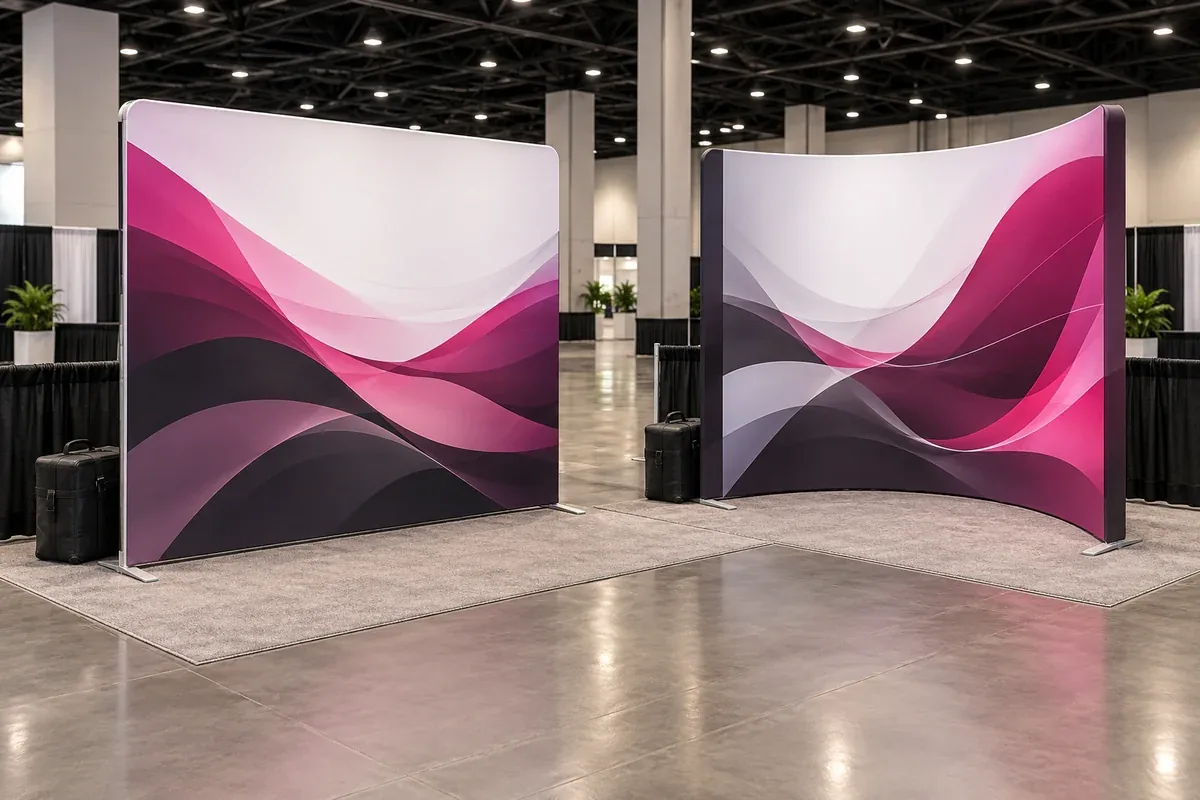
Straight and curved displays side by side
The two BoothBright walls share more than they differ. The straight tension fabric display and the curved tension fabric display both use an aluminum tube frame, a 7.4 oz/yd² (250 gsm) knitted polyester graphic, single or double sided printing, and a carry bag. Both come 8 ft wide or 10 ft wide at 8 ft tall. In the size selector the label lists height first, so 8 x 10 ft means 8 ft tall and 10 ft wide.
| Straight | Curved | |
|---|---|---|
| Profile | Flat face along the back line | Gentle arc that wraps toward the visitor |
| Sizes | 8 ft or 10 ft wide, 8 ft tall | 8 ft or 10 ft wide, 8 ft tall |
| Graphic | 7.4 oz/yd² knitted polyester | 7.4 oz/yd² knitted polyester |
| Frame | Aluminum tube | Curved aluminum tube |
| Printing | Single or double sided | Single or double sided |
| Lighting option | Optional two LED display lights | No lighting option listed |
| Floor depth used | Shallowest, frame and feet only | More, because the arc projects from the back line |
| Packing | Carry bag; catalog packing reference 31.5 x 10.2 x 11.4 in | Carry bag |
What a standard 10x10 booth actually gives you
The International Association of Exhibitions and Events (IAEE) 2023 Floor Plan Development Workbook describes standard, or linear, booths in the United States and Canada as units that are most commonly 10 ft wide and 10 ft deep, with an aisle on one side at the front. It gives a maximum back wall height of 8 ft for linear booths, and notes that 8 ft or 9 ft deep booths are sometimes used in smaller spaces such as hotel ballrooms.
That is helpful context, not a rule for your event. Your show's exhibitor manual and the venue decide the real booth dimensions, height limits, sightline rules, and what the back and side drape occupy. An 8 ft tall wall sits at the common linear limit, so check the manual before assuming any extra header or light arms are allowed above it.
A practical decision process for a 10x10
- Get the real space. Find the booth dimensions, back wall height limit, and drape details in the current show manual for this event.
- Measure the usable width inside the pipe and drape. If it is tight, the 8 ft wide option leaves room to place and adjust the frame.
- Decide how much depth you can spend. Sketch the table, counter, chairs, and a clear standing area for visitors, then see what is left behind them.
- Pick the profile. If depth is scarce or you need lighting on the wall itself, lean straight. If you want an enclosed, lounge style feel and have depth to spare, consider curved.
- Decide on sides. Single sided is usually enough against drape; double sided matters if the back of the wall can be seen.
- Plan the artwork for that profile, then measure the complete assembled footprint once you have it, before the first show.
Planning booth depth
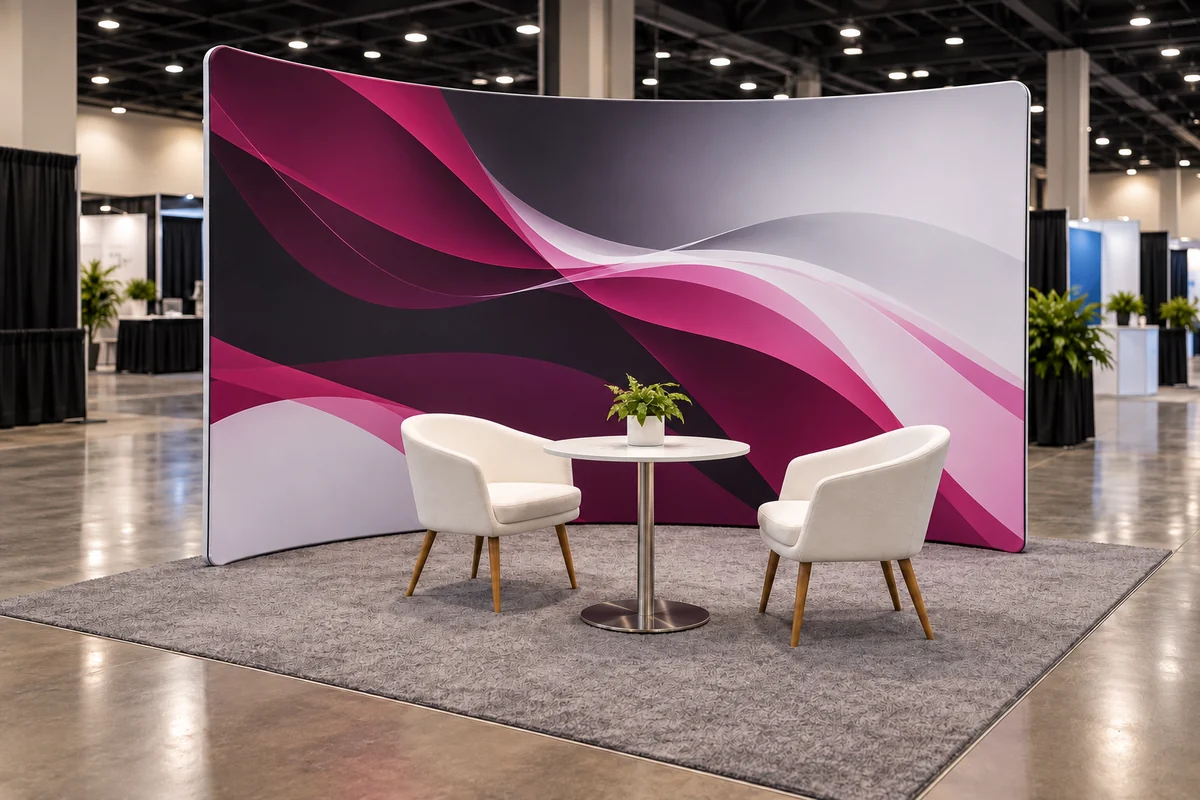
Depth is where the two walls truly differ. A straight wall stands along the back line, so nearly all of the booth's depth stays available. A curved wall's arc projects forward from the back line, and its ends or its center sit closer to the aisle depending on how it is placed. The BoothBright catalog does not list the curved frame's arc depth, so do not plan around a guessed number: ask us for the configuration details or measure the assembled frame.
Also count the frame feet, which extend beyond the fabric on both walls, and any counter or table in front. A wall that fits on paper can still crowd a two person conversation in a booth that turns out to be 8 ft deep.
Artwork for a flat face vs. a curved face
Tension fabric graphics are sewn like a pillowcase and stretched over the frame, so the design wraps around the edges. On a straight wall the whole face is seen at roughly the same angle, which makes it forgiving for logos, headlines, and photography. On a curved wall the outer thirds turn away from a visitor standing to one side, so text near the ends can foreshorten or disappear from some angles.
- Keep the logo and the one line that explains what you do in the upper middle of the wall, where it clears tables, people, and drape.
- Leave the lowest part of the wall for color and pattern; a table or counter usually hides it.
- On a curved wall, keep critical copy toward the center and use the ends for background imagery that still looks right when it bends.
- Avoid fine print and contact details near any edge, where the fabric wraps around the frame.
- Choose double sided printing only when the back face will really be visible, such as a wall placed away from the drape.
Start from the verified template for your exact size and follow the print ready artwork guide for resolution and color. The artwork templates page explains how to get the right file. If you would rather not lay it out yourself, request a free design and our team can help with the layout.
Lighting and accessories
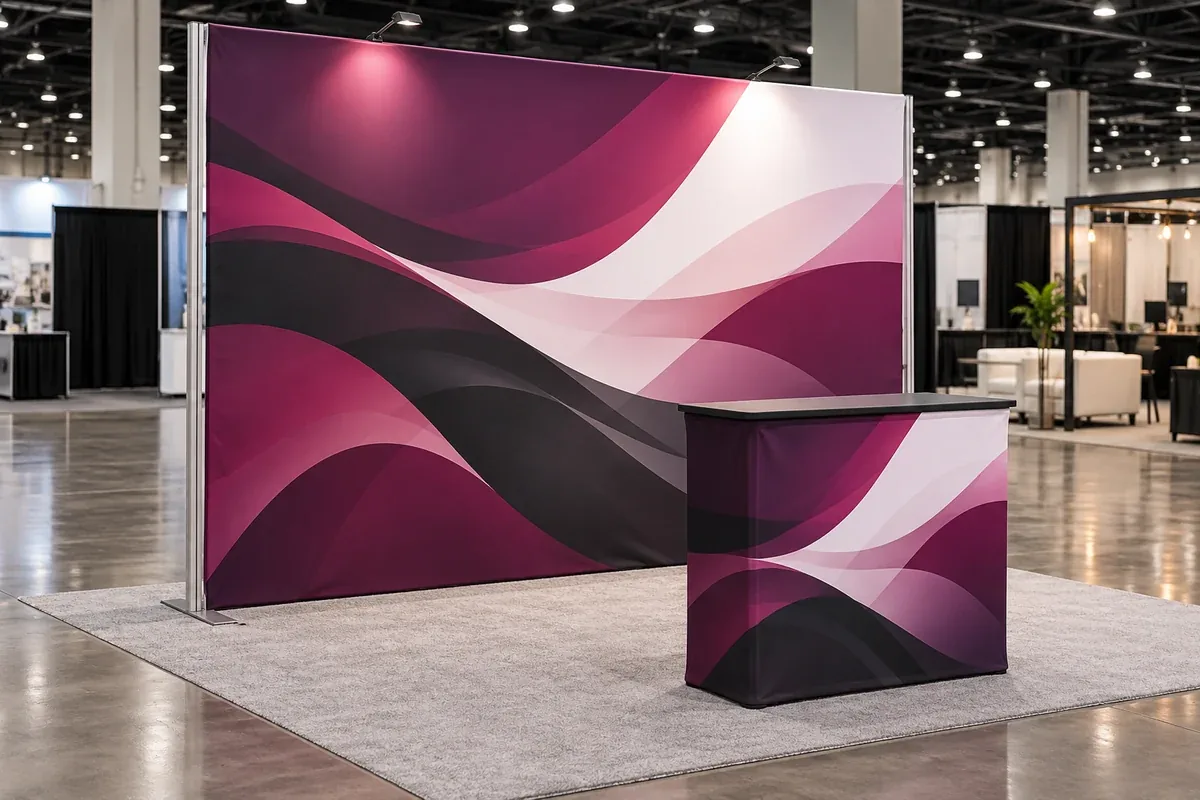
The straight display lists an optional set of two LED display lights in its configurator. The curved display does not list a lighting option, so plan venue lighting or a separate lit piece such as the portable LED light box display if light matters. Confirm the show's electrical rules and order power from the venue where needed.
In front of either wall, a portable promotion counter or a custom table cover gives visitors a place to stop. Browse every backwall and counter in trade show displays.
What to confirm before you approve the proof
- Profile is right: straight or curved.
- Width is right: 8 ft or 10 ft, and it fits the measured space inside your drape.
- Single or double sided matches how the wall will be seen.
- Logo and key message sit in the upper middle, clear of the table line.
- On a curved wall, no critical text sits near the ends.
- Nothing important sits near an edge where the fabric wraps.
- Colors, spelling, phone numbers, and web address are checked by a second person.
- Lighting choice is set on the straight display, if you want it.
Printing starts only after you approve the proof, so this is the last easy moment to change anything. If you have an event date, read the trade show display shipping checklist and work backward from your show's receiving window.
A worked 10x10 layout
An invented example to show the reasoning. It is not a customer installation, and every number here must be checked against your own show manual and measurements.
- Space
- Inline booth listed as 10 x 10 ft, with back and side drape and an 8 ft back wall height limit
- Measured
- Usable width inside the drape is a little under 10 ft
- Goal
- Product demos at a counter, with room for two visitors at once
- Wall choice
- Straight display, 8 ft wide, so the frame fits inside the drape with room to adjust
- Sides
- Single sided, because the back faces drape
- Lighting
- Two LED display lights, after confirming the show's power rules
- Front
- Portable promotion counter near the aisle, leaving a clear standing area
- Why not curved
- The arc would take depth the demo area needs; curved would suit a seated meeting layout better
Common questions
Will a 10 ft wide tension fabric display fit a 10x10 booth?
Sometimes, but not always. The 10 ft width matches the nominal booth width, yet drape uprights, frame feet, and the assembled footprint take space. Measure the usable width inside the drape and check your show manual before choosing 10 ft over 8 ft.
Does the curved display take more floor space than the straight one?
Yes. The arc projects forward from the back line, so it uses more booth depth than a straight wall of the same width. The catalog does not list the arc depth, so ask BoothBright or measure the assembled frame before planning furniture.
Can I add lights to the curved tension fabric display?
The curved display does not list a lighting option. The straight display offers an optional set of two LED display lights. For a curved wall, plan venue lighting or a separate lit display, and confirm the show's electrical rules.
Do I need double sided printing?
Only if the back of the wall will be seen. Against back drape, single sided is usually enough. Choose double sided when the wall stands away from the drape or its back faces an aisle.
What does 8 x 10 ft mean in the size selector?
The selector lists height first, so 8 x 10 ft is 8 ft tall and 10 ft wide. Both straight and curved displays come 8 ft tall in 8 ft or 10 ft widths.
Choose your backwall
Compare both walls with your measured booth in mind, then pick a size and sides. If you are unsure, our team can help with the layout before you order.
References
- International Association of Exhibitions and Events, 2023 Floor Plan Development Workbook (PDF) ↗ — Standard 10 ft x 10 ft linear booth units and the 8 ft linear back wall height; each show's rules still govern
- BoothBright straight tension fabric display — Current sizes, graphic, frame, printing, and lighting options
- BoothBright curved tension fabric display — Current sizes, graphic, frame, and printing options