
In this article
The short answer
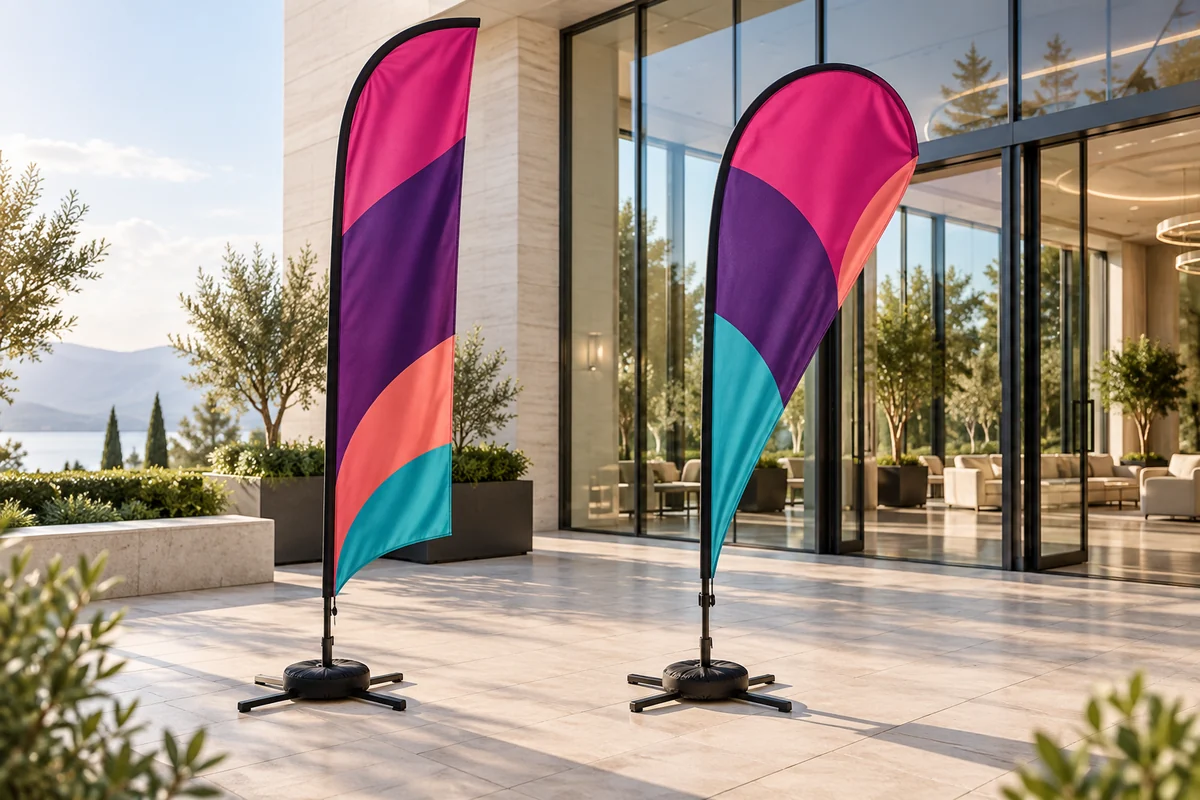
Choose a feather flag when you need the tallest, most vertical message area and want the option of double sided printing so both faces read correctly. Choose a teardrop flag when you want a tighter, rounder silhouette that holds its shape and keeps a compact logo centered in the widest part of the graphic.
In the BoothBright catalog both shapes are offered at 10, 12, 15, and 18 ft nominal heights on the same three bases. The clearest catalog difference today is printing: the Custom Feather Flag offers single reverse or double sided printing, while the Custom Teardrop Flag is offered with its standard printing and height and base choices.
Shape decides where your message can live
A feather flag is tall and narrow with a long curved leading edge, so the printable area is a slim vertical band. That suits a stacked layout: logo at the top, one short line of type beneath it, and a graphic element filling the lower third. Long words and wide horizontal logos get squeezed, because the panel simply is not wide anywhere.
A teardrop flag is widest near the top and tapers toward the base. The widest zone is the sweet spot for a round or square logo, and the taper below it is better used for pattern, color, or a very short word than for a line of small type. If your identity is a horizontal wordmark, a teardrop usually forces you to stack or shrink it.
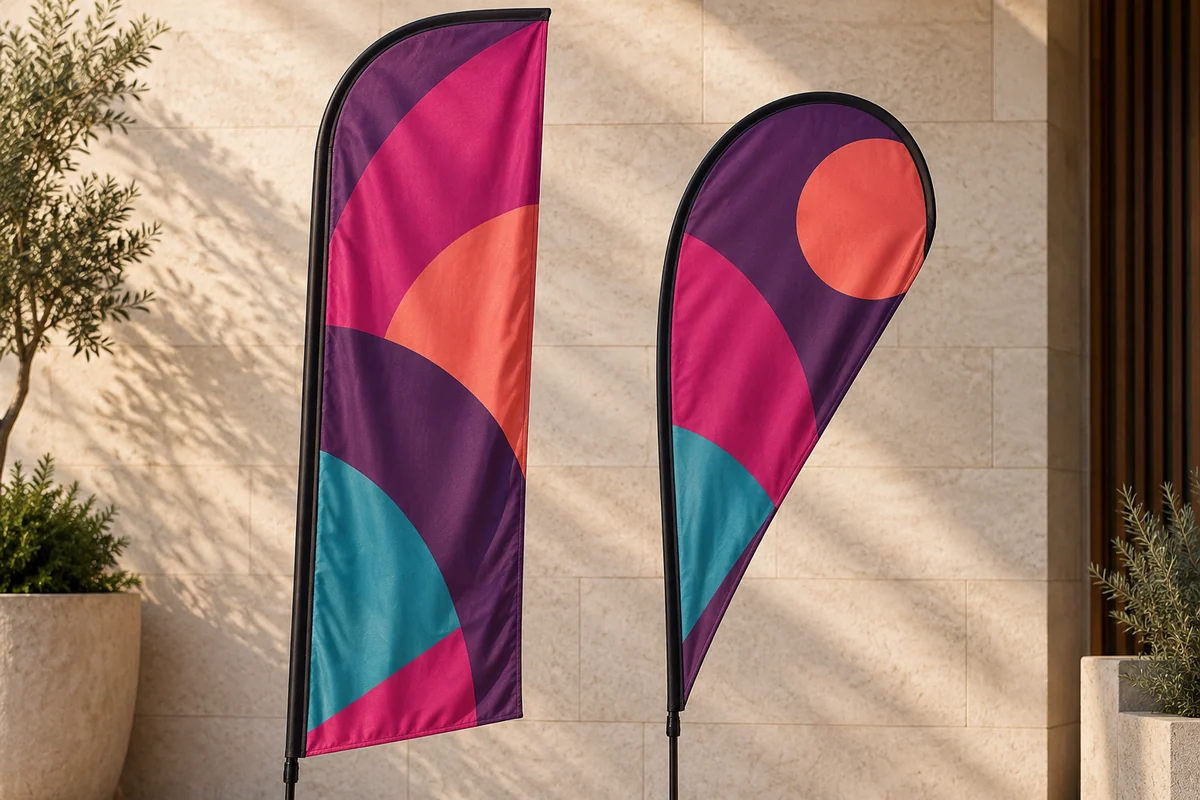
Orientation matters as much as area. Both flags mount along one vertical edge, so artwork is prepared in a tall portrait layout, and anything that must read horizontally, such as a phone number or a long URL, competes for the narrowest part of the panel. If your message needs horizontal room, a banner or a canopy valance is a better surface than either flag.
Single reverse versus separately printed sides
Single reverse printing puts the artwork on one panel. From behind, you see the same design through the fabric, mirrored, with reduced contrast. For a logo or a short brand name that is often perfectly acceptable, and it is the least expensive option. It becomes a problem when the reverse view carries the important information, because a mirrored phone number or a mirrored word is not readable.
Double sided construction uses two printed panels so each face reads correctly in its own right, and each side can carry different content. In the BoothBright catalog, double sided printing is a listed option on the Custom Feather Flag. If a specific display needs both faces to read correctly, confirm the exact construction for the product and size you are ordering before you approve artwork, rather than assuming every flag in a range offers it.
- One entrance, visitors approaching from a single direction: single reverse is usually enough.
- A flag in the middle of a walkway with traffic on both sides: plan for two faces that read correctly.
- Two different messages, such as a brand on one face and an offer on the other: this requires separately printed sides.
Side by side decision table
| Decision point | Feather flag | Teardrop flag |
|---|---|---|
| Silhouette | Tall, narrow, long curved edge | Rounded top tapering to a narrow base |
| Best logo shape | Vertical or stacked lockups | Round, square, or badge style marks |
| Usable text area | Slim full-height band | Concentrated in the upper widest zone |
| Catalog heights | 10, 12, 15, 18 ft nominal | 10, 12, 15, 18 ft nominal |
| Printing options listed | Single reverse or double sided | Standard printing; confirm options for your size |
| Catalog bases | Ground spike, cross base with water bag, heavy plate base | Ground spike, cross base with water bag, heavy plate base |
| Typical use that suits it | Roadside visibility, long entry drives, rows of repeated flags | Entrances, sponsor zones, tidy interior wayfinding |
Match the base to the ground you will actually stand on
Confirm the base before ordering, because it is chosen with the flag rather than improvised on site. BoothBright offers the same three base choices on both shapes, and each one assumes a different surface.
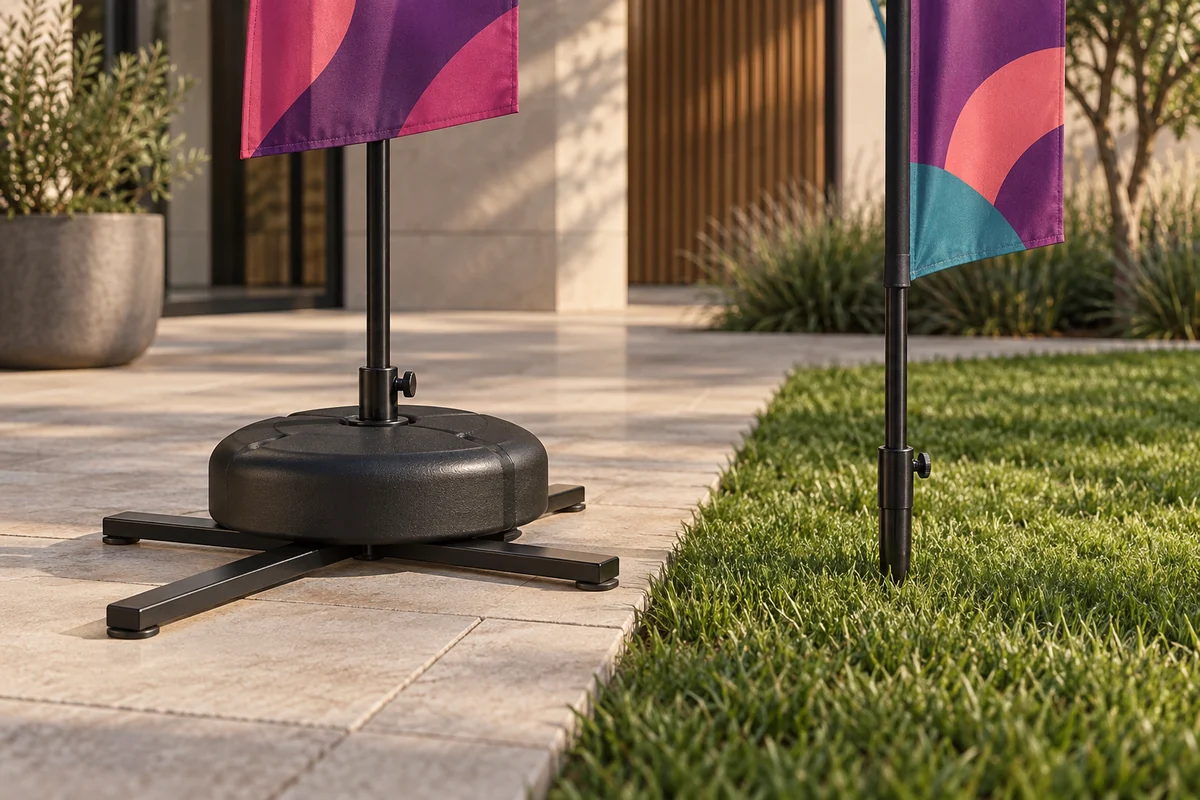
- Ground spike: for soil, grass, or a field where you are allowed to drive a spike into the ground.
- Cross base with water bag: for pavement, courtyards, and parking lots, where ballast replaces ground penetration.
- Heavy plate base: for smooth indoor floors and tidy exhibition spaces where a footprint should stay compact and stable.
Ask the organizer two questions before you order: may anything be driven into the ground, and is water available near your space. Those two answers usually decide the base by themselves. If you attend a mix of venues across the year, ask us about an additional compatible base for the same flag and compare the exact quote for that against a second complete flag.
Pre-proof checklist
- The shape you selected matches the layout your artwork was designed for.
- The logo sits in the widest usable zone, not in the taper or the curved edge.
- Nothing critical falls within the pole sleeve or the bottom hem area.
- Text is large enough for the distance people will read it from, not just large on screen.
- If the reverse must read correctly, the order specifies separately printed sides.
- Any second face carries the exact content you intend, not a duplicate by accident.
- The base matches the ground at every event you plan to use it at.
- Brand colors are called out for the print team rather than assumed from a screen.
- Spelling, phone numbers, and web addresses are proofread by someone who did not design the file.
Artwork requirements, file types, and color expectations are covered in more depth in the print ready artwork guide, which is worth reading before you build the file rather than after the proof arrives.
Common questions
Which shape is more visible from a distance?
Height and contrast decide visibility more than shape. A taller flag with a simple high contrast design reads sooner than a shorter, busier one in either silhouette, which is why both shapes are offered in four nominal heights.
Can I reuse the pole set and base with new artwork later?
Hardware and graphics are separate parts of the order, so a replacement graphic is normally the cheaper way to refresh a message. Match the original model, shape, and size before ordering a replacement.
Do I need double sided printing?
Only if the reverse view has to be read correctly, or if you want two different messages. When the flag stands against a wall, a fence, or a booth edge, single reverse printing is usually enough.
Not sure which silhouette suits your artwork?
Send the logo and the type of event, and the BoothBright design team can suggest a shape, height, and base combination before you order.